Fahrenheit (Indigo Prophecy) - Review (PlayStation 2, Xbox and PC game)

Fahrenheit' was released in 2005 by Quantic Dream and was really a sort of early experimental game that would set the stage for their later games of 'Heavy Rain' and 'Beyond: Two Souls

Never Alone - Review (PC, Xbox One and PlayStation 4 game)

‘Never Alone’ is one of those games that test the traditional boundaries of what a video game should be as it really is a vehicle for telling a larger story, one of the Iñupiat people and it goes about this in such a heart-warming way that it’s difficult not to enjoy it.

Last Inua - Review (iOS and PC)

‘Last Inua’ is set in a frozen tundra and is an icy tale of a father and son’s journey to vanquish evil from the world in the form of a demon named Tonrar. The son, Hiko, is blessed with supernatural powers strong enough to defeat Tonrar but his frail, adolescent body is unable to handle these powers and as such he is too weak to embark on this quest alone.

Machinarium - Review (PC and Mobile game)

'Machinarium' is a point and click puzzle game where you take control of a small, unassuming robot in a robotic society that’s victim to a gang of antisocial thugs.

Harvest moon, A Wonderful Life, SE: Befriending villagers and receiving gifts

Friendship points can be acquired in the traditional, ‘gift-giving’ method but also by giving villagers discounts at your store. This means that if you give them three discounts a day (the maximum number) and one gift a day then you’ve acquired four friendship points.

Showing posts with label Indie game. Show all posts

Friday, December 19, 2014

Never Alone - Review (PC, Xbox One and PlayStation 4 game)


This month we have another wintery game that explores ancient folklore only this time we’ll be delving into the beliefs of the indigenous Alaskan community, the Iñupiat. ‘Never Alone’ is one of those games that test the traditional boundaries of what a video game should be as it really is a vehicle for telling a larger story, one of the Iñupiat people and it goes about this in such a heart-warming way that it’s difficult not to enjoy it. The game itself is designed for two players, though can be played solo, and slots neatly into the category of a puzzle platforming game where you must navigate levels by controlling both a young girl and her arctic fox companion.

Developer: Upper One Games and E-Line Media
Genre: Puzzle platformer
Platforms: Xbox One, PlayStation 4, Microsoft Windows
Release date: 18th November 2014
ESRB: Unrated (mild threat)

The story of ‘Never Alone’ is presented as the kind of tale that an elder passes on to his or her grandchildren and even a few of the cutscenes are in a kind of scrimshaw style as though you are watching a living, breathing wall of cave art. It’s simple narrative that follows a young girl, Nuna, to find the cause of an unnatural blizzard with the help of an arctic fox whom she meets after narrowing escaping an angry ice bear. Together the two friends set out to find the source of an eternal blizzard which threatens the survival of not only the Iñupiat people but everything they have ever known. The story itself is pleasant, full of heart and somewhat magical in an ancient sort of way which really ties into the sense of the tale being told by an indigenous elder. What I particularly enjoyed about the narrative was that it offered up an insight into a culture that I was unfamiliar with and provided me with plenty of information in the form of cultural insight videos. These videos played like clips from a documentary and would discuss the relevant scenario, character or set piece that I had just encountered. Watching them as and when you unlock them can be rather distracting from the game however and I would recommend waiting until you had finished the game before going through them. They were a genuinely interesting watch though and you’d be missing out on some really interesting information by bypassing them entirely as they tend to make everything feel much more wholesome and real.


The game itself is quite clearly designed with two players in mind but, as I only have one controller, I only have a single player experience to talk about. That said, quite a lot of the game requires you to coordinate the movements of both the fox and Nuna so they work together in harmony but, with unpredictable AI, this is not always possible when you’re playing by yourself. Occasionally the character you are not controlling may perform actions that lead to their death and often they struggle to keep up with your pace which, inevitably, also leads to their death. The game is also slightly let down by the controls which can often feel sluggish, unresponsive and awkward to get right. Your ranged weapon, the bola, for instance can be very difficult to aim properly and this simply adds an additional problem to an already bothersome control system. On the positive side the mechanics of the game are pretty solid and generally revolves around a few basic ideas that become increasingly more complex as the game goes on. Whilst coming up against enemies is standard gaming-fare there are some interesting features such as the winter wind which can be both a blessing and an obstacle depending on where you’re trying to go or what you’re trying to do. Spirits that inhabit the game are similarly two faced and whilst there are plenty of good spirits who will help you there are also the not so good ones who may whisk you away at a moment’s notice. 


The game’s main premise however is the partnership between Nuna and Fox which is where some brilliant co-op gameplay would have come into play had I had another controller. Whilst Nuna can drag heavy objects and use the bola as a means of retrieving objects or clearing obstacles Fox’s expertise lies in his connection with the spiritual world, allowing him to work with the spiritual manifestations of animals called ‘loons’. Navigating levels tends to require you to switch constantly between the characters so that they may help each other along and there’s enough to interact with for this gameplay to not be boring or repetitive. However, the vast majority of the game does not have the same complexity that the final levels do which manifests not so much as a difficulty curve but more a great restriction on gameplay. In later levels your control over Fox is extended and you can do much more with him and, whilst the scenarios tend to be similar such as the chase scenes, everything is just so much more fun and challenging. It’s just a shame that it takes so long for the game to build up to this balance of play and before you know it the game has finished just as it felt like it was really picking up speed. What I am utterly grateful for after playing a certain similar game was the checkpoint system of ‘Never Alone’ as whilst death may happen quite frequently, dodgy companions aside, you are never put too far back and it never feels as though you are constantly retracing your steps.


What I absolutely adore about this game though is the art style which is so beautifully minimalistic with its soft focus and hazy wash of colours as though everything is thinly veiled with snow. Murky blues, whites and greys do wonders to make Nuna stand out in her fiercely bold furs whilst her Arctic Fox companion is both separate and a part of the frozen tundra that surrounds him. The simplicity but detail of the animations are also absolutely stunning and little idle animations like Nuna warming her hands or Fox pawing at the ground add a little subtle personality to their characters. The wind is flawlessly drawn and animated and you can visually feel the might of it as it throws Nuna backwards across the screen or sails across her shoulders when she’s ducked down, shielding herself from its buffeting power. The soundtrack as well is extremely well implemented, a soft chorus of piano that is only broken up by the shouts and grunts of Nuna and Fox as they struggle on with their task and overall the music has a very subtle and calming effect on the entire game. 


The prevalent issues that are present in ‘Never Alone’ are hardly even applicable at the moment as the developer has already announced that patches for both the PC version and the consoles will be released shortly. This is clearly a game with both substance and style and my only remaining gripe is that it takes far too long for the real action to get going and, with that in mind, the game is rather short. This aside it’s a wondrous little indie game that is well suited for modern day gamers who enjoy simplistic yet meaningful games with the capacity for a strong local co-op experience. Visually the game is stunning and I adored the focus on learning about Alaskan folklore as it is quite a rare culture to hear anything about, particularly in games. Treat yourself to something a little different this Christmas and check this out if it sounds like something you’d enjoy.

The Good:

  • Lovely depictation and explanations of Iñupiat mythology 
  • Adorable foxes always rank highly in my books
  • Very well thought out narrative spoken in the indigenous language
  • Engaging characters that develop a lovely relationship with one another
  • Pretty solid puzzles that require some thought
  • Stunning graphics and soundtrack
  • Nicely animated for the most part
  • Solid mechanics, particularly like the application of the wind and spirits
The Bad:
  • Later levels much more enjoyable than the rest of the game 
  • AI and ranged weapon issues (that are currently being patched)
  • Polar bear has some odd animations sometimes
The Score: 9/10

Final thoughts: “A genuinely intriguing game that makes me cold just thinking about it, or maybe it’s because I don’t have the heating on and it’s December. I loved the whole concept of this game and knowing that the vast majority of things I found wrong with it are being patched makes me truly appreciate the developer’s dedication to this game. I won’t forget this one.”

Thursday, December 18, 2014

Last Inua - Review (iOS and PC)

‘Last Inua’ is set in a frozen tundra and is an icy tale of a father and son’s journey to vanquish evil from the world in the form of a demon named Tonrar. The son, Hiko, is blessed with supernatural powers strong enough to defeat Tonrar but his frail, adolescent body is unable to handle these powers and as such he is too weak to embark on this quest alone. His loving father, the physically powerful Ataataq, opts to accompany his son and protect him in all the ways Hiko is unable to protect himself. Together this Inuit duo set out to save the North from Tonrar’s evil clutches and it looks to be a tale of fatherly love set in a tranquil, snow blanketed world. Unfortunately, ‘Last Inua’ faces a plethora of problems that spoil the experience. 


Developer:
Glowforth
Genre: Platformer adventure game
Platforms: PC and iOS

Release date: 11th December 2014 (PC), May 8th 2014 (iOS)
ESRB: Unrated (Mild threat)

‘Last Inua’ is a form of platforming game where you control both Hiko and Attataq in order to navigate the different levels though each character has vastly different strengths. Hiko, the teenage son, is gifted with the ability to teleport between glowing points, create bridges of light to pass over danger and fly in certain circumstances. Attataq on the other hand is the physically stronger of the two and may climb sheer, icy walls, jump and smash through enormous ice blocks that may block the path. To complete levels the player must use each character is unison and, at best, the puzzles are a solid means of traversing the environment even if your options are extremely limited. What let’s this game down however is how incredibly slow everything is and, when combined with some very touch and go controls, the whole experience is easily ruined. Both characters move at a lumbering pace as though they were wading through the snow rather than skipping across it and it’s a fairly frequent occurrence for your button presses to go unrecognized. Attataq in particular does not always jump when he is told to, usually resulting in death. This quickly becomes extremely frustrating as each death sends you halfway back across the map leaving you to plod your way back over to where you just died. This would be somewhat bearable if death was infrequent but sadly almost everything is deadly whether that’s mistimed jumps, roaming Yeti’s, spurting pools of darkness or spike traps. The entire game feels unnecessarily drawn out when you have to constantly retrace your steps at an agonizingly slow pace and this is inexcusable, no matter how pretty the backgrounds may be. 


Special mention should be made of how absolutely gorgeous everything looks and the opening cutscene in particular looks fantastic. The animations are nicely detailed and, for the most part, smooth and well executed. Visually, the art style is very simplistic but also very elegant and I personally loved the sleek, stylish appearance the game boasted as well as the noticeable contrast in colour. The first few levels are by far the most stunning as the contrasts between the inky black night sky and trees and the bright, gleaming whites and blues of the snow and ice are quite beautiful. The characters themselves are well designed and the landscapes have enough detail for them not to feel barren. A lovely visual effect that I enjoyed is also connected to a gameplay feature in that if you stay too far away from a campsite containing a fire then you will gradually begin to freeze to death. When this occurs the entire screen begins to fill with translucent spikes of ice that crackle across the screen, reminding you to seek warmth quickly or else face the ultimate consequence. 


Unfortunately ‘Last Inua’ is one of those games I really want to like but just can’t. It looks fantastic and the story is really quite lovely but the controls are unreliable, the animations are oddly jumpy in places, the lumbering pace is unbearable and there’s a great deal of repetition that makes the entire experience mind numbing. There’s a great deal of trial and error in navigating this game and, when error puts you so far back, you’ll find yourself constantly re-treading the same levels that already lack variety. Despite this, I’m sure there are people out there that can look beyond these problems and enjoy this quaint little game but for me it’s simply a deal breaker. Overall this game could have been so much better as there are some really promising elements about it that would have been brilliant if not for the undue frustration the mechanics caused me. So for this one I’m afraid I’ve got to say it missed its mark by a long shot. 


The Good:

  • It looks beautiful 
  • An emotional and touching storyline 
  • Nice animations, when they work 
  • An interesting concept 
  • Atmospheric, detailed environments 
  • Running from camp to camp before freezing is a nice touch
  • Some truly awe inspiring landmarks
The Bad:
  • Inexcusably slow
  • Puzzles are very scripted with limited solutions 
  • Unresponsive controls 
  • Frequent deaths that put you very far back from where you died
The Score: 6/10

Final thoughts: “What a shame, if only those kinks had been recognized and worked out prior to release then perhaps we’d have a real stunner on our hands. Sadly it’s just far too repetitive, slow and unreliable to enjoy properly.”

Tuesday, December 16, 2014

Year Walk - Review (iOS and PC/Mac game)

'Year Walk' is a game set to divide opinion due to its slow pace and quiet, ambient atmosphere. The game revolves around an ancient Swedish ritual called Ã…rsgÃ¥ng that required its partakers, called yearwalkers, to undergo a series of challenges that would allegedly result in visions of the future. These visions however may come at a grave cost as there is no guarantee the year walker will survive this ancient practice. As a lover of folklore the premise of the game was far too good to pass up and now, with the winter month fully descended upon us, I felt now was the best time to try it out. I wasn’t to be disappointed.

Developer: Simogo 

Genre: Puzzle, interactive fiction 
Release date: 21st February 2013 (iOS) 6th March 2014 (PC), 3rd April 2014 (Mac)
Platforms: iOS, PC and Mac
ESRB: Unrated (Horror imagery)


‘Year Walk’ is very much one of those ‘interactive fiction’ type games where it feels as though you’re playing through some kind of novella rather than an actual game and its strongest features are by far its chilling atmosphere, obscure storyline and sublime aptitude at weaving together horror, fantasy and folklore. You play as a mysterious person who has chosen to partake in the ‘year walking’ ritual in an attempt to predict your future and this starts out with saying alone in the dark, whilst fasting, during New Year’s Eve. When the clock strikes into the New Year you leave your solitary confinement and walk around the forest that surrounds the cabin, meeting strange and frightening creatures that offer up challenges in the way of puzzles for you to solve. 


What I particularly liked about the game was how it drew you in with just enough mystery to peak your interest but then made it quite difficult for me to find out what was going on. Initially the game is quite frustrating as it feels as though you’re just walking around in circles and getting nowhere. Everywhere I turned I found myself locked out of somewhere with no obvious way of getting in and it took a while for me to realize that I really needed to pay attention to the smallest of details in order to navigate not only the twisting and turning woodland but the game itself. A pen and some paper turns out to be absolutely essential for this game as jotting down everything from landmarks, patterns, symbols and even your path through the forest as its very easy to get turned around and find yourself lost, despite the presence of certain key landmarks. What really struck me however was the actual appearance of the game as there’s just something about its very simplistic artistic style that reminded me of a hand crafted Christmas card where everything is rather whimsical and ethereal. Spindly, silver skinned trees stand boldly against a velvety backdrop, the snow crunches beneath your feet as you are inexplicably drawn deeper and deeper into the dark, mysterious world. ‘Year Walk’ has such a fantasy feel about it that it feels as though you are exploring a gentle winters scene in some pure and innocent fairytale but the creepy imagery and frightening jump scares drop you back into reality with a bump. The constant clashing of splendor and viciousness keeps you on your toes and is very effective at maintaining the emotion that comes with an ever changing, ever evolving reality where nothing is as it seems. 


This is one of those games that sticks in your mind long after you’ve finished playing it, haunting you as though there’s something else in the snow blanketed world that needs to be revisited. Its haunting storyline, horrific scares and utterly immersive atmosphere all amount to an extremely unique experience that, for the modest price tag, is worth diving into. I should mention at this point that you may sink rather than swim in this grim tale as it’s a puzzle game with a whole new level of difficulty. In fact, I found some moments of the game utterly unbearable not because of its poor quality but of how frustrating and obscure I found the puzzles to be and there was plenty of time spent struggling on through things I found could have been made a little clearer. Now, don’t get me wrong, I love a challenge and I admit that games have become significantly easier in recent years but when you spend a good ten minutes on one puzzle a little resentment does start to build. It’s not until I was fully absorbed in the ‘puzzle game’ mind frame where I started to take note of every tiny detail and utilizing my ‘companion app’ guide to learn more about the folklore that I really started to make headway. 
 

The companion app is an unusual addition but, after initially dismissing it as an added extra for those who enjoy reading in games, I realised it had a noticeable effect on the game itself. At first it appears as though the companion app is simply detailing the ritual of year walking in full detail, providing additional information on the symbols and characters you come across, but towards the end you find that you may enter a passcode into the journal. It’s not until you have ‘completed’ the game and come back to that journal that you find the game is far from over as the full story is revealed to you through additional gameplay and scenes. 


Something I found slightly problematic about Year Walk was the controls as it was originally made for touchscreens. Several puzzles require you to move your mouse in the same way you would a finger which, for me, felt really strange and I was glad there were no reaction based puzzles as this would have been pretty hard to re-enact with a mouse. Whilst the controls are nicely interactive for touchscreens, for instance using your thumb print to activate certain stones, there were times when the game was unclear about what kind of user input was required, leaving me to paw helplessly at the screen until something worked. Translated onto a PC what this tended to result in were plenty of puzzles that you didn’t know how to even begin tackling them due to the zero amount of guidance from the game.

‘Year Walk’ is sadly a very short game that, provided you knew all the answers to the puzzles already, would take a pretty meager 30 minutes to complete. The only thing that really extends the length of the game is the difficulty of the puzzles and I would have loved additional gameplay and more storyline as the game is such a unique experience it seems a pity not to extend it with additional content. That said, the pacing of the game is fantastic and nothing is rushed and, whilst the slow nature of the game may annoy some, I enjoyed the softly softly approach to exposing the mysteries that this game held. The emphasis on audio appealed to me, from the audio based puzzles to the enchanting music but this may necessarily prove to be problematic for those with hearing difficulties. The game has no spoken dialogue, everything is text based, but the requirement to hear for the audio based puzzle may stop many people from progressing in the game and it’s a shame there’s no alternative. Minor niggles aside, ‘Year Walk’ is all in all a pleasantly surprising game that is very sleek and very intelligent in its design and the way in which everything plays out and slots together. I adored this means of learning about Swedish folklore and I enjoyed the complexity of the story that, when you get around to completing it the first time, only gets better and better. I can imagine this game is not for everybody due to its slow pace, emphasis on atmosphere and frequently frustrating moments but for me it was a delight to play and I highly recommend it.

The Good:

  • Very stylish game
  • A constant uneasy atmosphere that something's wrong
  • Beautifully artistic
  • Genuinely creepy with plenty of scares
  • Inclusion of the companion app is a nice touch
  • A unique way of learning about folklore
  • Intelligent, well pieced together, good pacing
  • A story that keeps you guessing, even after it ends
  • The kind of game that stays with you after you've finished it
The Bad:
  • Audio puzzles
  • Zero guidance when solving puzzles results in a lot of guesswork 
  • The controls for solving puzzles are frustrating 
  • Rather short in length 
  • Slow pace may annoy some
The Score: 9/10

Final thoughts: “I’m so glad I finally got around to playing this in time for Christmas, it’s an absolutely stunning game with so much creativity and thought poured into it. It was such a twist to find out its horror elements but the creepy imagery worked really well with the dreamy nature of the game.”

Monday, November 24, 2014

Machinarium - Review (PC and Mobile game)


It was love at first sight. From the moment I first saw ‘Machinarium’ sitting in the list of recommended games I knew it was to be mine. For a price so meager it was almost an insult I downloaded an exceptionally tiny game of around 200MB and proceeded to be astounded by a puzzle game that was bursting with personality, story and beautifully hand drawn artwork. 


Developer: Amanita Design

Genre: Adventure, puzzle, point and click
Release date: 16th October 2009 

Platforms: Microsoft Windows, Linux, Mac, Android, OS X, iPad 2, Windows Phone
PEGI: 7+ (some violence)

'Machinarium' is a point and click puzzle game where you take control of a small, unassuming robot in a robotic society that’s victim to a gang of antisocial thugs. What pulls this game aside from the competition is most certainly its art style, just look at those screenshots, it’s a beautiful game that perfectly portrays a crumbling, rusting city and citizens living on the brink of existence. There’s so much detail and so many little touches to the environments and animations that you can only truly appreciate it by playing it yourself as the screenshots alone don’t do it justice. Your nameless, noiseless robot protagonist is quite obviously a character who’s lived under the thumb of others his entire life and in the first ten minutes you see him discarded in a rubbish tip, turned away by the authorities and then plummet into a grotesque sewer system. His somewhat bullied ‘childhood’ is hinted at in the same primary communication that all other characters utilize; soft, inoffensive thought bubbles that either reflect on past events or communicate what they want from you. Even without words it’s easy to empathize with your humble robot character as he totters about, helping others and trying to do some good in a corrupt and rundown city where crime is king and the mechanical officials are about as helpful as a robot bathhouse. 


Yet it’s not just its unending charm that’s there to impress, graphical style and personality can only carry you so far after all, ‘Machinarium’ thankfully manages to bring in a solid compilation of puzzles, smooth and thoughtful storyline additions and overall a fair bit of bang for your buck. The game’s by no means long but there will be times you’ll be held up trying to advance as the puzzles usually require some thought and not everything is immediately obvious. Whilst the puzzles generally rely on some good old item combination then using items in the world environment there’s a decent spattering of originality in the form of its unique ‘stretching and shortening’ feature of your robot friend.


In a traditional ‘Bender’ fashion you can lengthen your robots legs to the point where he can access previously out of reach areas or shorten him to a hobbling, squashed up little robot that can do all sorts of things in this new, skirting board level territory. It’s different and its interesting and what strangely appealed to me is the influence of retro gaming that makes its appearance in old, disused arcade machines and the in-game walkthrough that can only be accessed by playing through increasingly difficult levels of a spaceship game. I liked this allusion to how everything is old and past its time and I also liked the option to use a walkthrough in-game but by earning it through a rather difficult mini-game that didn’t feel out of place at all in the overall scheme of things.


With ‘Machinarium’ there’s just this feel that everything slots together and everything’s very well thought out and crafted from tiny animations like the slurping up of a coil of string when you pick some up to the slow, measured teetering movements when you’re tall. Everything you do has a special animation that will make you squeal with excitement, well maybe not squeal, I do get a little overexcited with indie games, but you get my point, it’s cool stuff. The game is incredibly cheap for what you get and quite honestly I can’t think of a game quite like this one from its design to the way it plays out it’s most definitely an experience and one I applaud for both its squeal-inducing ability and its confidence at portraying a silent hero in a rusted world. All in all, I loved it, even if I am five years late to the party. 


The Good:
  • Very well animated, lots of attention to detail
  • Beautiful, hand drawn graphics that constantly impress
  • Interesting areas to explore
  • Full of personality
  • The lack of dialogue surprisingly pleasant
  • Pretty decent storyline with room for a sequel
  • Challenging puzzles that will keep you guessing
  • Extremely atmospheric
The Bad: 
  • A little slow in places
  • Some puzzles are extremely difficult
The Score: 9/10 

Final thoughts: "I genuinely struggled during this game as the puzzles are pretty damn hard, and frankly the walkthrough mini-game is no walk in the park either. Regardless, the game is well worth playing as its beautiful, full of personality and presenting quite a unique experience and premise."

Friday, October 31, 2014

The Cat Lady - Halloween Special Review (PC game)

Susan is no longer with us; she’s gone to the world and, even before her suicide, she’s been gone a long time from society’s apathetic eye. But even after taking copious amount of sleeping pills Susan is still unable to escape her miserable existence as she awakens in a field, unsure of whether this is life, death, or somewhere in between you take control of her life and guide her staggering footsteps through the world, searching for a way out; of where, neither you nor Susan truly knows. Whereas death is supposed to be the end of a story for Susan Ashworth, it’s the beginning.
Developer: Harvester Games
Genre: Adventure/Horror/Point and Click
Release date: December 1st 2012
Platforms: Microsoft Windows
ESRB: M - Mature


‘The Cat Lady’ follows Susan’s journey back to life after she meets an old woman who wants to strike a deal with Susan to allow her the peace she longs for. Susan is instructed to seek out and destroy several monsters that lurk in the world of the living on behalf of the old woman. Despite Susan’s misgivings she finds herself powerless to resist and, after a brutal and bloody way of sealing the deal, finds herself transported back to ‘life’ but with a catch; she’s now temporarily immortal. For many, this would be a wondrous gift but for an exhausted, suicidal woman it’s an ironic curse that points and laughs in Susan’s face as she treks on with her journey and seeks to complete her task just so she can rest her weary soul and finally be allowed to die. 


The Cat Lady game review screenshot shower curtain

It’s a cryptic, surreal and often disturbing journey that encourages you to lose yourself in the darkness of depression before guiding you out of it again. This is a game where the monsters are not aliens with guns or gloomy figures lurking down the other end of a corridor, this is a game where you are the monster in the dark as Susan is flung between anger, doubt, regret, fear and anxiety as she longing for death yet craves revenge. The creatures you encounter are reflective of the demons of Susan’s soul that, as anybody who has suffered from depression will tell you, are not easily vanquished. There will be a blood, and not just a little bit, the game is unashamedly macabre and Susan is forced to undergo several brutal deaths only to be cruelly resurrected again. The imagery of the game is morbid as well and at least every single chapter has a way in which the player may allow, or actively encourage, Susan to kill herself. There’s plenty of black humour in the game as well which I found appealing as, though this game touches on very serious subjects, it’s easy to become jaded to the horrific nature of things when you’ve lived with them for so long. Whilst the game has some extreme scenes of gore these tend to be offset by slower, storyline focused cutscenes so it’s not just a blood-fest, it’s a very well written and intelligently explored blood-fest. If anything, I would describe this as a game that is beautifully horrific. 


The Cat Lady game review screenshot paintings

Whilst the narrative is by far its strongest point the puzzles are actually fairly good, though not extremely difficult, if anything they are there to provide you with a means to an end rather than as something to frustrate you and slow your progression. Since the game is mostly about atmosphere and storyline I didn’t mind that the puzzles were a little easy but, saying that, they were no walk in the park either and I had several moments of backtracking and getting confused as to what I had to do next. Importantly, the puzzles didn’t feel repetitive and the constant switching of environments helped in this aspect as nothing ever felt like a chore to proceed and it was all very much necessary and interesting. Some puzzles feature some obscure clues about how to complete them that are not just restricted to visual ones, there’s a fair few aural cues which are great for the atmosphere of the game. Generally, I found the audio very good even though the voice acting came across as a little stiff now and then and there’s a very irritating sort of static noise that’s quite loud and intrusive yet entirely intentional. I would have preferred that to have been either non-existent or with the option of turning it off as it was distracting and often made the characters hard to hear. The musical score is brilliant and I have no complaints there and, whilst I said the voice acting could be a little wooden at times, it occasionally did suit the atmosphere and I get the feeling that the developers wanted everything to be very drab and unemotional. Unfortunately at times this style did not suit the on-screen events. 


The Cat Lady game review screenshot butcher gore

The beautiful horror of this game is wrapped up in its storyline but enhanced by the unique art style that is a cross between animated newspaper cuttings and old Polaroid photographs giving the entire game a gloomy yet striking appearance. Just like Susan’s life, everything feels a little pasted together but despite this the animations are smooth, the facial expressions are detailed and everything just flows so perfectly. Visually, the game feels very much like a 1990s game which for a point and click puzzle game is just the perfect era for me, especially with it being a horror game as it reminds me strongly of much beloved games such as ‘I Have No Mouth and I Must Scream’, ‘Sanitarium’ and ‘Phantasmagoria’. Amusingly, the game also feels quite 1990s due to the very low resolution that it plays in but this doesn’t bother me so much. There are a couple more problems with ‘The Cat Lady’ though that does tend to spoil the experience a little; the controls for instance are fairly unresponsive, especially during dialogue when you’re trying to skip lines you’ve already read. Susan also does walk incredibly slowly and at one point I was quite sure I had time to go make a cup of coffee in the time she walked from one side of the screen to the other. When you’re lost and backtracking to find things, this is extremely irritating though it may just be my own impatience. Simply, a ‘double clicking to skip to the next screen you clicked on’ feature may be good as I recall several point and clicks doing this in the past. 


The Cat Lady game review screenshot beginning field

Complaints aside, I was utterly entranced by this game and it’s by far one of my favourite point and click adventure games, even with the huge spattering of horror and gore that’s been slapped all over the place. It’s a brilliant example of mature themes that have been done right in a way which is thoughtful, sensitive and intelligently where it doesn’t shy away from controversial issues yet doesn’t make a mockery of them either. If themes such as suicide, mental illness, depression and death offend you then this is not a game you’re going to get on well with as it is utterly unashamed in its approach to the reality of how some people want to die and will go to any length to do so. Whilst the gore side of things can be sometimes a little over the top I found it shocking yet, oddly, refreshing as there have been plenty of these sorts of games that never go too far and tend to pull back before things go too far. ‘The Cat Lady’ never pulls back, it’s in it to win it and I love that about it. The story is fantastic, full of emotion, suspense and drama that will keep you on the edge of your seat and second guessing yourself the entire way through. Susan herself is a brilliant character with genuine character development as you see her go from shy, meek and weary to a woman with a purpose, confidence and strength and quite simply it’s a pleasure to guide her through these changes. If there’s one game you play this Halloweeen, make it ‘The Cat Lady’, you won’t regret it.

The Good: 

  • Strong character development
  • Interesting, captivating storyline that keeps you guessing
  • Mature themes done right
  • Striking yet low-key appearance is very appealing
  • Decent inventory/dialogue puzzles that challenge but don't frustrate
  • Very surreal and disturbing atmosphere
The Bad:
  • Some audio issues such as hit and miss voice acting/distracting static
  • Some may find the use of gore over the top
  • Controls can sometimes be unresponsive, Susan walks too slowly
The Score: 9/10 

Final thoughts: "This has definitely become one of my most beloved point and click games, everything about it feels a bit 90s adventure game which I love and frankly it's been too long since I played something this surreal and this creepy."

Sunday, October 19, 2014

Lovely Planet - Review (PC game)

Who said twitch shooters had to be set in grisly wartime settings or cerulean alien worlds? Lovely Planet may look incredibly sweet in its 'Katamari', chibi style dressings but underneath it all is a game that will beat you mercilessly into the ground with its rainbow encrusted, spiked, bouncing apple type, addictive thing that will quite literally drive you to madness. Let’s try this again. Lovely Planet is an FPS that’s set in a rather cute looking world where you must have a stunning set of reactions and the ability to memorize pathways to perfection in order to get through the extremely challenging levels. Sounds easy? It’s not, it’s far from it, it’s quite possibly the first twitch based FPS that’s genuinely addictive and also so punishing and cruel that it doesn’t mind coming across as a bit airy fairy and cutesy because it knows it could totally have you if it wanted to. You will lose at this game, many many times, you will become so familiar with the game over screen that you’ll be able to recite it from memory years after putting away this game for good. Quite simply, this game is a lying bastard that tries to convince you it’s totally approachable and easy to get into then floors you with the first punch. Now that you know how difficult it is, let’s examine it in a bit more detail. 


Developer: QUICKTEQUILA 

Publisher: tinyBuild
Genre: First-Person Shooter, Action
Release date: 31st July 2014
Platforms: Windows, Linux and Mac
ESRB: Unrated (involves shooting enemies but the bullets are cubes)

Lovely Planet is a first person shooter where you must complete a series of short levels that are no longer than one minute long and which typically last about 30 seconds. There are initially over 80 levels but there are more once you complete all of them; typically this serves as an additional stab to the side considering how long it takes to complete those ones in the first place. In order to complete each short level you must navigate platforms, avoid hazards and defeat all of the enemies presented to you and by missing just one you will have to restart that level. The courses are extremely challenging and this is partially due to the constraint of having to hit certain things before you hit the ground which results in a great deal of trying and failing to aim in mid-air. Thankfully you’re granted an infinite number of ‘bullets’ with your one and only weapon but there’s little use just spraying the screen with the purple cubes that you shoot. The key to mastering this game is to know the course by heart and to act with speed and precision which is not an easy task due to the sheer number of levels and the seemingly impossible situations the game puts you in. The slightest mistake will kill you whether that’s being hit by a single bullet, falling out of the world or touching anything that’s red there are so many ways to end up restarting the level. It’s basically one of those games where you master a small part of it, then get stuck on another bit, then creep a bit further along as you overcome that particular challenge, and then get stuck on another bit… and so on. 


To ramp up the pressure the game encourages a healthy dose of competitiveness among its players through leaderboards and record times which serve to constantly remind you at how much you suck compared to the rest of the world. Not that that’s a bad thing, in fact it’s a very appropriate feature because part of what makes this game so addictive is seeing yourself improve, whether that’s in comparison to others or not. Critically, the controls of the game can sometimes be a little ‘off’ where inputs aren’t always recognized but this is a fairly rare occurrence and is not frequent enough to impact on the overall game. Strangely there’s no actual aiming cross-hair either so firing shots is harder than in a usual FPS game but, after some practice, you’ll find yourself firing with accuracy you didn’t even know you could manage as everything becomes almost instinctual. Besides, at a mere £3.50 you can excuse a couple of blips on what is otherwise a fantastic game. 


Considering I don’t usually enjoy anything of an FPS nature this is genuinely a fun, albeit frustrating, little game that may attract all sorts of gamers to try it out either for a quick blast about or for some seriously dedicated gaming to get through all of the courses. Either way, it looks and sounds great, with adjustable sensitivity in the controls and plenty of features to keep you occupied for hours. Whilst the sound effects aren't exactly the best they're overwhelmed by a very upbeat music track that reminds you that everything's going to be ok, even when you die for the 100th time. If you fancy a challenge, check this game out now by purchasing it on Steam here.

The Good: 

  • Fast and crazy funtimes
  • Good for those who enjoy a challenge
  • Nice escalating level of difficulty
  • Unique art style for this genre
  • Decent soundtrack that's surprisingly not annoying
  • Simple mechanics
The Bad:
  • Lacks some variety in terms of gameplay
  • Occasional lag with the controls
  • Incredibly frustrating game that may put off many people
  • Unable to compare yourself directly to friends is disappointing
  • Sound effects aren't very good particularly enemies 'dying' noise
The Score: 8/10

Final thoughts: "I suck so much at this genre of games that I'll likely never get to see the ending or the later levels. I tried, I failed, I moved on with my life. That doesn't stop it from being an amazing game, I'm just awful at rote memorization of levels." 

Monday, October 6, 2014

Among the Sleep - Review (PlayStation 4, Windows/Linux/OS X game)


There are always things we’re going to be afraid of, that much is certain, but it’s the things we are most uncertain of that tend to terrify or aggravate us the most. As children we lacked the understanding that we have now and trying to cope in a world where we’re unable to reason away the existence of monsters or understand the steps to take when you find yourself alone. This helplessness and vulnerability is the very core of what makes survival horror games so terrifying and usually this vulnerability is due to a lack of weapons, an abundance of darkness and a big splash of threat that is often unseen. In ‘Among The Sleep’, you’re dropped right back into the footy pyjamas of a toddler soon after his 2nd birthday party where he received a bite of cake and a slightly odd looking, talking teddy bear. You awake in the middle of the night to a strange commotion in your bedroom and, after you’ve been flung from your crib, you venture out into the dark corridors to find your mother for some much needed comfort. Unfortunately, she’s nowhere to be found. 


Developer: Krillbite Studio
Release date: May 29th 2014
Genre: Survival horror
Platforms: Microsoft Windows, OS X, Linux, PlayStation 4,

ESRB: Rating pending (likely to be a 16+/Teen rating)

Playing as a toddler is in itself a novel experience but what is particularly appreciable is the way in which tasks we would find simple as an adult become an instant challenge for a toddler such as the opening of doors. Although the mechanics can be a little clunky there’s a sort of realism to this as by dragging around say, a chair, you’re not only struggling to walk on two feet but you have to move a heavy object whilst you’re at it. In 'Among the Sleep' you have the ability to switch between walking, running and crawling and quite appropriately the crawling is a much faster way of getting around though, down there, you cannot interact with anything. This presents a problem in that you are significantly more vulnerable when you’re unable to see where you’re headed, interact with things or use your ‘flashlight’ which is actually a light emitted from hugging your teddy bear, awwh. ‘Among the Sleep’ has a fair few puzzles that are more about getting to your destination than solving anything too complex and the game itself is running off a ‘find three items’ objective that are obtained by going through very different areas. You start out in your house, naturally, and then move through increasingly more surreal areas that are wonderfully varied and consistently offer you new and interesting places to explore.


The places you tend to explore are, unsurprisingly, dark. By dark I mean, 'can barely see your hand in front of your face', kind of dark, so that teddy bear hugging I mentioned earlier is an extremely useful feature. As you can only hug your bear when you’re standing upright what tends to occur is a trade-off between being able to see where it is you’re going and getting there quickly enough. This is a surprisingly stressful situation to be placed in constantly as once you’re left alone in the darkness your over-active child’s imagination comes to life and things appear far much terrifying than they usually would do. Whilst the game isn’t necessarily full on horror there’s enough of an atmosphere that will drive you onwards and ensure you never want to linger too long for fear of what’s lurking in the shadows. The game tends to put you through phases of thinking there’s something there, to believing it’s just your imagination, to making you definitely think there’s something there and this rollercoaster of fear and paranoia will make you constantly question everything around you. 


What I’ve yet to mention is how fantastic the game actually looks and almost everything is interactive whether that’s a piece of fruit in the kitchen or a soft toy in your bedroom; everything can be picked up, carried and put wherever the hell you want it to go. All chairs can be dragged around whether you need to move them or not, drawers and cupboards can be opened and generally there’s a huge amount of detail. Even in places you’re not really supposed to explore you’ll still find a very respectable level of furnishings whilst the textures and detail have not been skimped on adding to a rather realistic, if slightly cartoony, feel. The game’s appearance also significantly contributes to the atmosphere of the game and little things like well-timed thunderclaps, partially lit corridors and the ability to hide under furniture at any given time with no prompting results in you questioning yourself about whether you need to be hiding or not. You’ll often second guess yourself in this game and there are some stupidly terrifying moments such as turning a corner and seeing a dark figure looming over you, just around the corner and out of sight, you turn to stumble away and then realise it’s, well, just a coat on a coat rack. You rarely get those experiences playing as an adult as you would almost immediately see its lack of a face but, as a toddler, all you get is the bottom of a coat and a pair of shoes and this whole new perspective puts you at a disadvantage even for seasoned survival horror gamers.


Don’t let me convince you that this game is all about running from your own shadow however as, trust me, there’s something out there to get you and though I won’t spoil it for you it’s definitely something that makes its presence known. Try as you might you cannot deny the tell-tale rattling of a door handle as you watch something unseen opening a previously looked door from the other side. Neither can you ignore turning around to see that, somehow, something you thought was inanimate has moved and now it’s standing right behind you, staring at you, still unmoving and leaving you very little choice but to slide around it, desperately hoping it doesn’t decide to wake up and do anything else whilst your back is turned. 


Overall

‘Among the Sleep’ is certainly a memorable game and a very unique experience that is well worth a look at, even if you don’t usually play horror games. Whilst the storyline tends to take a backseat during the main chunk of the game it is generally explained through the opening and closing cutscenes with some general illusions to what’s going on as you play. The game is by no means dull however and though it is in no way comparable to gore fests such as 'Amnesia' and 'Outlast' it’s deserving of its place as a horror game due to the undeniably spooky ambiance and the constant fear that something’s about to jump out at you. There are mechanical issues with the game, particularly when climbing on objects, but these can be generally excused as the rest of the game is very attractive with a strong, vibrant pallet and lashings of attention to detail. Occasionally I encountered some frustrating moments of not knowing where to go but generally the game is just about the right level of difficulty and it was probably just me struggling to put 2+2 together though, at times, the puzzles were somewhat lame. The game is unfavourably short at around 3 hours long and I would have definitely preferred a longer game with more build up and some more scares but, overall, the upcoming DLC should settle down the need to spend longer in this oversized world.

The Good: 

  • Brilliant storyline, thought provoking ending
  • Very atmospheric with a constant eerieness
  • Interactive world and puzzle elements are a nice addition
  • Looks very clean cut with bold, vibrant graphics
  • Sounds fantastic with brilliant voice acting and high quality ambient sounds
  • Original concept that was risky for developers but worked out great
  • Few scare tactics used, instead more of an investigation into fear
  • Playing as a toddler offered up some very interesting and new situations
The Bad: 
  • Could have had 'more going on' in it
  • Climbing mechanics need to be worked on
  • Should have been longer with more build up
  • The teddy bear is more creepy than comforting
The Score: 8/10

Final thoughts: "The ending is extremely poignant and made me glad I continued all the way through. I loved the concept of playing as a toddler and am extremely glad somebody took the initiative to put this into a game, now I want to watch everybody I know play it."

Thursday, September 11, 2014

Five Nights At Freddy's - Quick Review (PC and Android game)


If there’s one thing that’s going to effectively terrify me it’s those things that are supposed to be innocent, but aren’t. You know what I’m talking about; clowns, dummies, children’s toys, giant humanoid animal costumes, the horror genre has been drawing on the things from our childhoods and turning them into our greatest nightmares long before the arrival of ‘Child's Play’ or ‘Killer Clowns from Outer Space’ so it’s no great surprise to see them in horror games as well. ‘Five Nights at Freddy’s’ is set during the hours of midnight and 6am as you, the new night watchman at Freddy's pizza place, must attempt to survive with limited defences against some horrifyingly deadly mascots. This is a game where your own paranoia and attempt at protecting yourself will push you closer to sealing your own twisted fate as each and every nervous twitch lowers your resources and, ultimately, your chances of survival.

Developer: Scott Cawthon
Genre: Survival Horror, Point and Click
Release date: August 8th 2014 (August 27th for Android)
Platforms: PC and Android
ESRB: M - Mature

‘Five Nights at Freddy’s’ works its way deep into my own insecurities and draws out of me a fear I didn’t even know I had until this game. The enemies you’ll encounter are anamatronic animals that sing and dance for children during the day, annnnd attempt to stuff the new night guard into a suit filled with cross beams and metal bits during the night. Needless to say, this action would kill you so it’s your new priority to survive five nights as the new security guard because presumably he really, really needs the money and values his life less than this. It sounds crazy but who am I to judge, finding work is difficult these days and the fact that you’d have to physically nail me to the chair to get me to stay there is no bearing on what this guy would do, apparently. 
As an added extra you can define the AI of each individual enemy for two additional nights where, upon completing all five nights, you'll notice a night six is suddenly available. The reward for completing the seventh night is not just bragging rights at your own stubborn survival but in valuable storyline explanations where you finally learn the dark secrets behind the deadly mascots.

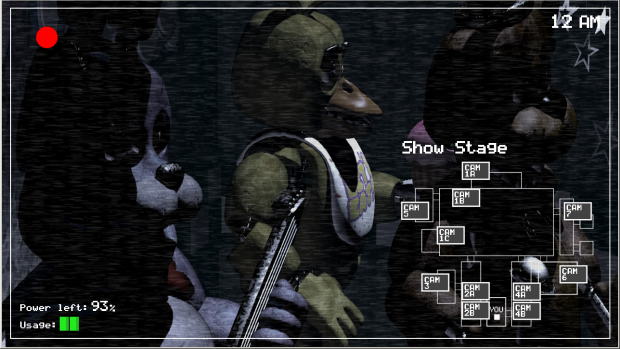
Five Nights At Freddys Screenshot Stage

In order to survive five nights at this disturbing pizza place you must carefully manage your power supply whilst monitoring a bunch of CCTV cameras to watch where those dastardly murdering critters are going. They only move when you’re not watching them, reminiscent of the Weeping Angles from ‘Doctor Who’ which can only spell trouble, so by ignoring the cameras they’ll just walk on over to where you’re sitting and tear your face off. The building’s power percentage is tracked in a corner and every time you use a camera, flicker the light just outside either of the two doors to your security room or close the doors to protect yourself it’ll drop how much power is left, significantly so. There’s quite a few cameras and unfortunately a couple of them only have audio feeds so you can only listen to the ominous grinding of their motors as they shuffle down a corridor, worse still, there are plenty of blind spots. Cruelly, those blind spots are mostly right outside the two doors that lead to your little security room so you won’t know they’re in there until they’re either grinning at you around the doorframe or if you manage to hear their, fairly stealthy, movements. 


Five Nights At Freddys Screenshot Pirate Cove
 
Whilst a lot of survival horror games utilize a player’s fear of being helpless, ‘Five Nights at Freddy’s’ cranks it up another notch by adding in the complete inability to move. So basically you’re stuck in a tiny room, unable to move and quite possibly nailed to that chair I mentioned now that I think about it, maybe the owners had to resort to brute force with their staff, who knows. Your only line of defence is closing the doors and even then, there are two of them on opposite sides from one another and they use up a lot of power so you can only close them very briefly. You have to survive from midnight to 6am in the morning which takes just less than 10 minutes of your life but at least three years off your life due to the stress it causes. Every night is harder than the last and whilst you’ll quickly adjust to the manner in which you must organize yourself the difficulty intensifies dramatically for the final two nights. The AI of the creatures can vary and they’re fairly unpredictable but generally they’re a lot faster and a lot more intelligent as you progress through the nights. Initially they’ll stay still backstage for the start of the night but, come Night 5, they’ll have mysteriously vanished from their usual spot as soon as your shift starts leaving you to switch between cameras manically, trying to pin point their location. 


Five Nights At Freddys Screenshot Duck

What makes this game so effective at terrifying the living daylights out of you is how well it plays on your paranoia and nervous twitch reaction to check a camera or check the doorway, reducing your power in the progress. Whilst you need to constantly check where everyone has shuffled off to it’s difficult to reign this in and not flicker constantly, dooming yourself in the progress, and the feeling that it’s your own increasing OCD checking of everything that’s narrowing your chances of survival is very unsettling. What's particularly likeable about this game is it’s an extremely simple yet imaginative concept that breaks away from the current trend of ‘Slenderman’ or ‘Amnesia’ trend of snooping about houses, collecting up notes and newspaper clippings that many horror games are copying. Overall I found this game to be an imaginative addition to the survival horror genre and whilst the overall style and concept is extremely simple it's still a creepy venture into a nightmarish world of grinning, killer mascots and a gruesome story that you're gradually rewarded with.


The Good: 

  • Simple, original and very effective concept
  • You become your own worst enemy as you double check, triple check everything
  • Decent jump scares keep you on your toes
  • Disturbing character design
  • Very atmospheric, feelings of isolation and helplessness predominant
  • Looks and sounds great with very good voice acting
  • Final two 'bonus levels' add in an element of freeplay
  • Quite a brutal difficulty curve but the challenge is welcomed
The Bad:
  • Although Night 2/3 offers up whole new gameplay feature, more variation would still be good.
  • Tends to degenerate into careful time management which some may find boring.
The Score: 8/10

Final thoughts:
“Some more variation in gameplay would have gone a long way, but this had me constantly jumping out of my skin as the AI are so unpredictable and it’s got such a disturbing atmosphere.”

Friday, August 1, 2014

Broken Age, Act 1 - Full Review (PC/Linux/Mac, Android and iOS Game)

'Broken Age' seemed like the perfect game for me to play but, upon completing Act 1 in its entirety, I was left with a confused, almost guilty, feeling of disappointment and frustration. What made it worse was that reputable, professional websites had glazed the game with sickly sweet praise and admiration, hailing it as a fantastic example of point and click adventure games. I rather strongly disagree, as you’re about to find out, and though I admit the storyline is fantastic there are far too many basic elements missed out for this game to be considered as ‘one of the greats’. That said, this game is certainly a steal at its low price and overall the game is very good value. 
 

Broken Age Act 1 Vella and Shay sleeping

Developer: Double Fine Productions 

Genre: Point and click adventure 
Release date: 26th January 2014
Platforms: Windows, Linux, Mac, Android and iOS
ESRB: Not rated (some mild threat, no blood/gore)

The backstory behind the development of this game is far from ordinary. To begin with, 'Broken Age' is one of the most crowdfunded video game projects as it acquired a whopping $3.45 million from more than 87,000 backers. The project began in 2012 and the game marked Tim Schafer’s return to the point and click genre after his fantastic game, Grim Fandango which is being re-released for PS4 and Xbox One and which was originally released in 1998. Despite its extreme backing though it appeared that this may have actually lessened the quality of the game. The end result is, whilst visually polished, wrongly suited to the originally intentioned audience and, quite simply, an inadequate addition to Schafer’s portfolio. As a standalone indie game this would be fantastic but unfortunately it failed to live up to the hype.

Gameplay and storyline

'Broken Age' Act 1 is made up of two different stories, that of a girl named Vella and of a boy named Shay and each story has vastly different settings. Regardless of which character you start with you’ll likely find that the game comes across as very cutesy and perhaps even a little too sickly sweet but this is simply a façade. Without going too far into the storylines the characters have in common a desire to break traditions in their lives that have, up until now, gone unquestioned. The gruesome realities of what is actually occurring strips away that initial sweet demeanour and instead the cheerful nature of the characters and environments take on a whole new form, one that is much darker and much, much more unnerving. 


Broken Age Act 1 Vella in dialogue about cloud shoes

It’s here where 'Broken Age' truly excels as the storyline is quite fascinating and will draw you in with its twisting story and cheerfully disturbing atmosphere. The ever present, in your face, indication that something is wrong but nobody else seeming to notice it is a constant source of fascination and you will desperately want to find out what’s going in in the two strange realms that you’ll inhabit. The characters too are likeable though, admittedly, quite unemotional and rather bland despite the famous voice actors. Whilst the storyline is interesting enough and with brilliant twists there are some key issues with the game that are very difficult to ignore. To begin with, it feels as though it’s being aimed at a much younger audience and not at those who would have previously enjoyed classic graphic adventures such as Grim Fandango and the Monkey Island series, both of which Tim wrote for previously. The complex puzzles, standard ‘pick up everything you can find’ mentality, vast environments and wry sense of humour that typically lift a standard point and click to a successful one have all been stripped away leaving something quite superficial in its wake.


Broken Age Act 1 Vella at the Maidens Feast

Overall there’s a genuine lack of content and substance as characters have very few dialogue options and the environments are very limiting so there’s simply not much to discover in what could have been sprawling worlds of characters, places and puzzles. The few characters that are present are quirky and interesting but you can never just chat to them and waste away a couple of hours getting to know their unique personalities so, in this sense, the game feels a little sparse. There’s this strange, unfinished feel about the game that’s reflected in not only the lack of character development but the small, limited environments. These rather simplistic environments quickly become a problem when you’re faced with one of the many puzzles in the game. Often, a point and click adventure game would have you picking up random bits of, seemingly pointless, tack with plenty of red herrings thrown in there just to screw you up. Large locations or, in the very least, a broad variety of areas where the solution to your puzzle may lurk is key to making a puzzle difficult as often you’ll be searching doggedly for more items, racking your brains to figure out what kind of obscure combination you need to come up with. Broken Age lacks this, entirely so. At one point I had to find a particular, very important, item that had been lost but I found it sitting out in plain sight on just the next screen. Another puzzle simply consisted of getting to end of a conversation. It’s almost as though the developers didn’t trust their players to continue playing if they found the puzzles too challenging and this lack of faith in players is evident in the huge amount of hand-holding that takes place


Broken Age Act 1 Shay at a children's playpen terminal
  
When important plot elements have been stripped away of challenge it’s not just frustrating, it’s disappointing. I find it hard to imagine this game ever becoming ‘one of the greats’ and instead it sits as something which is nice, different, but nothing special. The lack of puzzles and choices meant that the length of play was disastrously short and far too easy for seasoned graphic adventure gamers and, whilst some hail this as a return to the 'nostalgic' era of point and clicks, it feels painfully modern with a strong focus on visuals and not enough on actual, substantial, gameplay.

Graphics and audio

The artwork of the game may not be to everybody’s taste but it truly is quite beautiful with a strong hand painted, fantasy appeal. The style and design of the worlds and its inhabitants does nothing for its childish feel however and overall it’s all a little bit too cute and quaint. Despite this, the worlds are gorgeous with a stunning array of colours and details that make each and every area feel bursting with life. The contrast between the two storylines is very apparent, not only in its gameplay content but in the design of the environments. The differences between the smokey oranges and dreamy pinks of Vella’s world to the moody blues and vibrant preschool colours of Shay’s world simply add layers onto the, already distinctive, atmosphere. A curious feature present within the game is its ability to be played in a ‘retro’ graphical mode which makes the game appear in an slightly pixelated, pre-renovated 'Monkey Island' 1 and 2 type design. Whilst usually I would have been extremely interested in this it’s clear that the game was not designed to be played in this format so it comes across as a very low quality conversion. If anything, it looks as though you’re just squinting at the HD version. 


Broken Age Act 1 Vella talking to a tree

The audio is, overall, very good and I liked almost all of the voice acting except for several occasions where I found the protagonists to have a lack of emotion. Despite pushing the budget out and employing the talents of very talented actors including Elijah Wood as Shay I felt as though Shay’s emotion was completely out of context with what was occurring in the scene. When his dialogue was supposed to indicate frustration the voice came across as depressed, when he was supposed to be confused he sounded passive. Though this is partily intentional as Shay is fairly a depressed character this uninterested tone persists even in moments of great peril where what he is saying suggests he's feeling emotion. The voice of Vella too had some inconsistencies between script and the voice acting and overall I felt there to be a lack of emotion when faced with action packed, highly distressing scenes and this tended to ruin the scene’s atmosphere. Aside from this, the game sounded as good as it looked and there was plenty of general chit-chatter in the background and little comments from the protagonist which gave you a better insight into their character.

Overall

It would be easy to simply look at the game, its history and its origin and stamp it with the mark of ‘fantastic’, ‘ushering in a new era’ and things of the such but upon closer examination, Broken Age does none of these things. It’s boringly simplistic, painfully unemotional and with very, very little build up to anything that happens. I found the storyline enjoyable, gripping even. My attention was constantly drawn to what was going on on the screen and Shay's story in particular was a mixture of fascinating and hilarious. My desire to find out more about the strange world I’d been dropped into was what primarily kept me going however as the gameplay was rather simplistic and, generally, the more I progressed the more let down I felt. 


Broken Age Act 1 Shay receiving hugs

The game had a lack of depth, a lack of real challenge and, also, a lack of something else, something I can’t put my finger on, it’s as if it very much lacked the heart, soul and dedication you’d have expected from a game with so many backers, so much time poured into it and so many people working with it. I don’t know what happened to render this game so disappointing and it’s a great shame to say that about what could have been one of the greatest modern age point and clicks. I hope wherever Tim Schafer is now that he looks on this game and thinks to himself, ‘I could have done better’ because if he doesn’t then I’m not sure what happened to his creativity in that sixteen year hiatus. Whilst my disappointment is evident I’d like to finish by saying that I will play the upcoming Act 2 to 'Broken Age' but, truly, it’s only to find out what happens in the end. I can only hope it presents something more appealing to lovers of classic point and click adventure games.

The Good: 

  • Different, original storyline
  • Attention grabbing with its odd premise
  • Beautiful, hand painted graphics
  • Lovely animations
  • Nice variation of environments
  • Likeable, personality filled characters
  • Great cliff hanger
The Bad:
  • Far too easy, a lot of hand-holding
  • Not enough puzzles
  • Voice acting can be off in places
  • Limited, small environments
  • Not much to explore or discover
  • Very little to no item combination
  • Feels superficial and focused on its graphics
The Score: 6/10

Final thoughts: "I'm looking forward to playing the next part of this but only because of its storyline. The game is far too easy with limited environments and, generally, it just doesn't feel like a traditional point and click."